Table of Contents
About Catherine Servatius-Schot
Catherine Servatius-Schot is one of those people who makes you feel welcome in about three seconds flat… then gets you moving before your brain can negotiate its way out of it.
She is a physiotherapist specialised in oncology care, with a particular focus on breast cancer rehabilitation, and she’s deeply convinced of one thing: movement matters – before surgery, after surgery, during chemo, during hormone therapy, and long after treatment ends.
In her aquagym sessions, Catherine blends a therapeutic mindset with real training goals, all wrapped in warmth, humour, and the kind of supportive group atmosphere that helps people feel like themselves again.
Her Teaching Style
Meet the Coach 📸
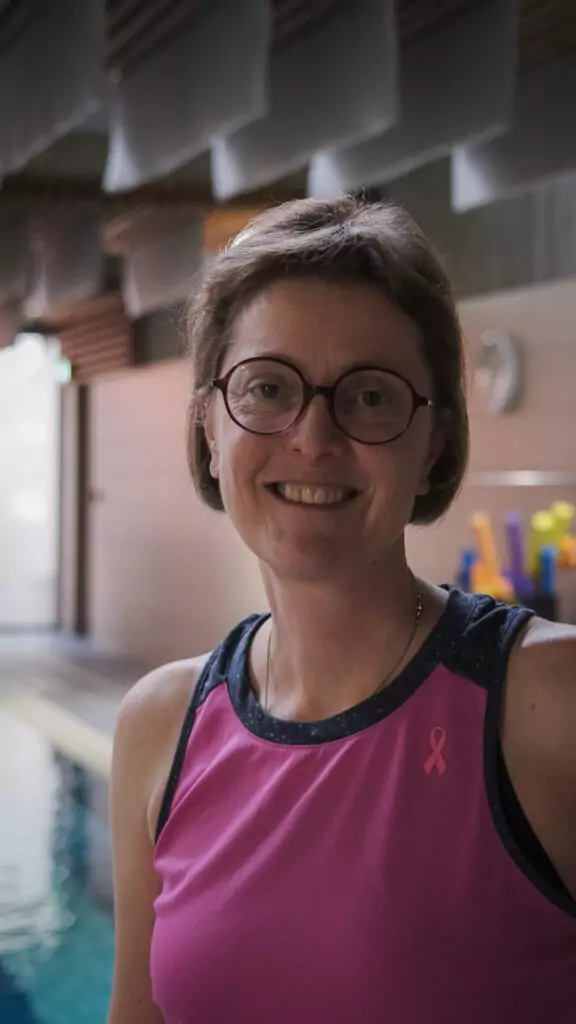
An Interview with Catherine Servatius-Schot
Catherine is Belgian, originally from Bastogne, and she’ll be the first to tell you that humour and self-mockery are “in the blood”. She’s also a mum of four, a movement-lover, and a clinician who’s seen, up close, how hard it can be to tell patients “you should do sport” and then watch real life get in the way.
That’s exactly why she built something better: a water-based class that feels safe, welcoming, and genuinely doable – without losing the therapeutic purpose.
Could you share a bit of your background and what inspired you to work with cancer patients through sport?
I’m a physiotherapist and I specialise in supporting oncology patients, especially those who have had breast cancer.
It became clearer and clearer that physical activity is extremely important for these patients.
In my day-to-day practice it was difficult to put into place, because we often say: “Go on, you need to do sport,” but we realised that sometimes it was difficult and they didn’t go.
The more (medical) training you do, the more you realise just how important physical activity really is. So I told myself: “I need to find something. I need to do something so that they come and do sport.”
Catherine’s motivation is very practical and very caring: she didn’t want movement to stay as a recommendation on paper. She wanted a solution that people would actually come to: something supportive, accessible, and realistic for where cancer patients often are, physically and emotionally.
It’s very Catherine: warm, practical, and quietly determined, with a “let’s stop talking about it and make it happen” kind of energy.
I was lucky to meet a physio colleague who told me about a physiotherapist who is part of the ALGSO, Maxime. We met, and straight away he said: “I have something to propose: we have the possibility to run aquagym classes at the Schifflange pool.”
Originally, I wanted to go for forest walks because I love the forest… but my physiotherapy practice is very close to Schifflange, so I thought: why not, let’s go!
And honestly, I’m delighted (even if I’m still in love with my forest) to be in the pool, because the water has a lot of benefits.
And here, we’re so lucky! We welcomed like royalty, so it’s really brilliant. I’m really very happy with how it turned out.
In other words, Catherine’s path into oncology sport came from two things meeting in the middle: her clinical focus (oncology and breast cancer rehab), and her refusal to leave patients alone with a vague “you should exercise.” She saw the barrier, and she built a bridge: one that people actually want to cross.
How did you find yourself in the world of oncology?
In my private practice, I had quite a lot of patients and the demand was there. I had all these patients but I didn’t feel I was good enough for them. So I did more training and specialising, and then I had more and more cancer patients.
And I have to say that beyond the technical side of the physio, there’s a human relationship with this kind of patient that I really, really love.
It’s this humanity side of things that means soon I’ll have almost only oncology patients. It’s really my field now.
Catherine speaks like someone who has seen the long road up close: not just treatment, but everything that comes around it, and after it too.
It’s not only mobilisation, it’s not only drainage, it’s a whole package they need: pre-op, post-op, during chemo, and throughout hormone therapy too.
And in remission too, because physical activity reduces (or limits) the risk of recurrence. I truly believe that.
What do you love most about this class?
My biggest joy is seeing their smile after class.
We arrive and we’re all a bit low on energy (me too!), but we leave and they’re smiling, they’re happy.
They say: “Oh, I’m glad I came. It was a bit hard, but it feels good.”
Catherine loves that aquagym doesn’t feel like “another appointment”. It feels like a good moment, with real benefits.
And it’s so joyful! You don’t always have that when you leave a physio session.
How do you create such a good atmosphere?
There’s always music.
Catherine starts with what sets the tone immediately: sound, rhythm, and a room (well… a pool) that feels alive. She doesn’t aim for “quiet and serious”. She aims for warm, upbeat, and welcoming: the kind of atmosphere where you forget you were nervous five minutes ago.
It’s happened that, at the end of the year we’ve put Christmas music on and it worked really well.
We have some Italian participants, so I put on some Italian music once! They sang and danced, it was great fun.
And if you’re wondering who the DJ is… Catherine laughs and admits she’s no playlist wizard:
For playlists, honestly, it’s my husband who makes them because I admit I’m not super good with music… but there’s everything that creates atmosphere. Of course, there’s a lot of 80s music.
We even tried Oktoberfest music once… it was… interesting! We laughed a lot!
But the atmosphere isn’t just music. It’s Catherine herself: her energy, her humour, and the way she brings people together without making it feel forced.
I think I have a lot of energy, so I try to transmit that. (She really does, trust us!)
And we always laugh.
She’s very natural about it (in the best possible way): warm, self-deprecating, and with that instinct to make people feel part of something.
I’m Belgian, originally from Bastogne. And humour, self-mockery… it really is in the blood.
And I come from a big family: so for me, the more we gather, the more we laugh.
And then there’s the playful, light-pressure motivation that makes people push a little harder… while still smiling.
We make jokes like: “First one to drop the pool noodle buys us all a hot chocolate.”
And the group energy has grown so much that they even ended the year with a team moment that sounds like pure joy:
At the end of the year we did a little water polo match, and I was really surprised how much they were into it! It was really funny.
What Catherine is describing, really, is a class where people don’t just exercise, they connect. She loves the convivial side because it helps people who arrive shy or isolated, to gradually feel safe enough to laugh, chat, and belong.
People arrive a bit shy, they’re on their own, and now they talk… there’s blooming. And people are less alone, I think, in their illness.
It’s not that we only talk about that. On the contrary, it’s always very positive.
And of course, sometimes in the group there is someone for whom it’s going less well, and then they’re all there to encourage and surround them.
No, it’s really great… there’s real mutual help and good support.
So Catherine’s recipe is simple, and very effective: music, humour, energy, little surprises, and a deeply human group spirit. The result is a class that feels like community… with cardio.
Do you have examples of success stories or transformations from your class?
Catherine doesn’t hesitate here, because for her, “success” isn’t only about performance. It’s about confidence, comfort in your body, and that quiet moment where someone realises: I can do this now.
She starts with a story that says a lot in a few sentences: a participant who arrived with fear, and slowly turned it into freedom.
I had a lady who was rather scared of going into the water because she couldn’t swim… and she was especially afraid to lie on her back with the noodle… or to go forward holding the edge with the board. She couldn’t (and wouldn’t) do it before… but now, no problem! She is even openly enjoys it!
For Catherine, that’s a big win: not because floating with a noodle is an Olympic event, but because fear can be such a powerful barrier, and this class gives people a way to face it safely, without pressure, until the fear softens.
Then she talks about another kind of transformation: people who were told to do sport, but had never done it in their life, and who now show up consistently, week after week, proving to themselves that movement is possible at any age.
I think a big success is managing to get women of 82 years old who have never done sport before. People told them to do it, and they come to my class and hop! They come every time, without missing a single one.
That “hop” is very Catherine. She’s smiling as she says it, because what she’s describing is both moving and joyful: the moment someone who never thought of themselves as “sporty” becomes a regular.
But one of her most powerful examples isn’t physical at all. It’s about body image, vulnerability, and the kind of safety that’s hard to find in public spaces after cancer:
I have another participant who would never dare go to a gym or to another pool because of the way other people might look at her body.
But here, it’s really a calm environment, kind, without judgement, and we can all feel it.
At the beginning, they all went into the small individual changing cabins. And now, they’re all in the shared changing room.
For me, that’s a huge success. It means they’re at ease. They’re at ease with their bodies. They feel good.
A personal message from Catherine:
Come and try it: we laugh, we move, we adapt… and you leave with a smile.
Catherine’s Class Schedule
Activity: Aquagym in Schifflange
When: Every Thursday from 1:30pm – 3pm (except during Luxembourgish school holidays)
Where: Piscine de l’École Lydie Schmit, Schifflange
Who for: Open to all ALGSO members

